
The Sovereign Threshold:
On the Powers of Hospitality and Boundaries in Traditional European Magical Practice
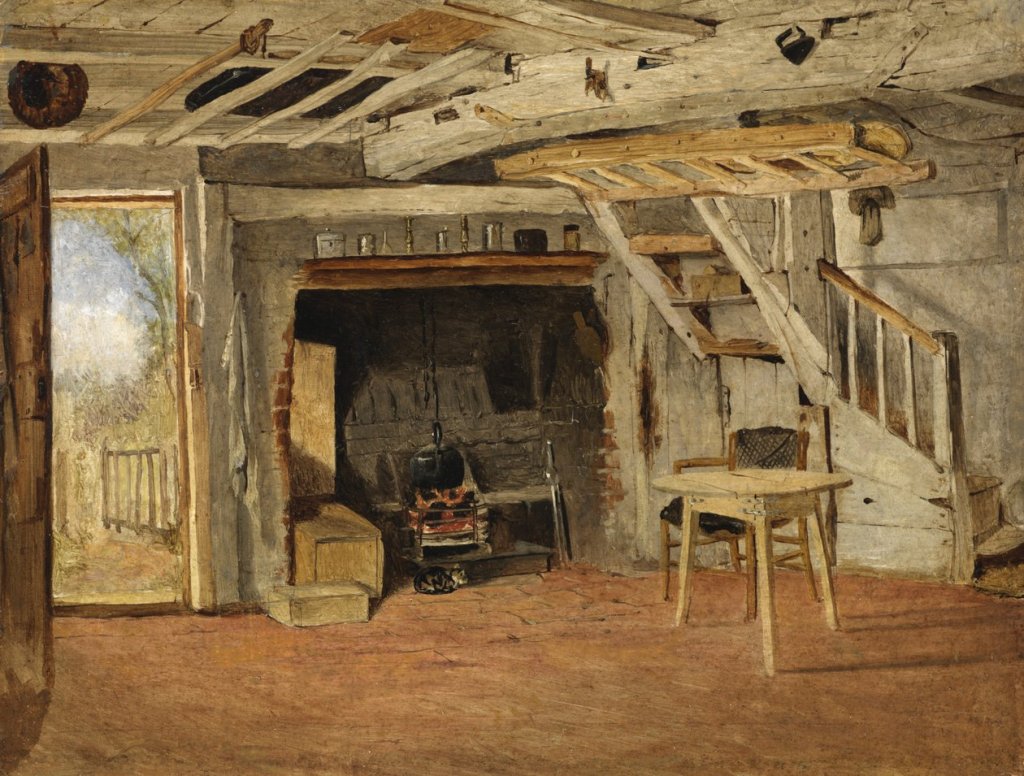
Hospitality may be one of humanity’s oldest magical technologies. Long before circles were traced upon the floor or divine names inscribed around a conjuration, there was the threshold: the door and its lintel, the boundary stone, the hearth, the table at which bread was broken and salt shared. These were ordinary structures of human life, but ordinary things have always made excellent vessels for extraordinary meanings.
Across the folklore, mythology, and ritual traditions of Europe, the division between the familiar world and the dangerous, sacred, or uncanny one was not always located in some distant heaven or subterranean Otherworld. It might be encountered at the edge of a field, beneath a hill, beside a well, where two roads crossed, or—perhaps most intimately—at the door of the home. To cross such a threshold was not necessarily a neutral act. One might enter by invitation, or one might enter by trespass, and that distinction contains within it an entire magical philosophy.
Hospitality is often mistaken for openness, but the two are not synonymous. Hospitality requires a boundary. There must be an outside from which the guest comes, an inside into which the guest is received, and someone with sufficient authority over that inside to say, You may enter. The significance of the open door derives precisely from the fact that it could have remained shut.
In many premodern societies, hospitality carried obligations extending well beyond courtesy. Feeding, sheltering, gifting, and protecting strangers created relationships between people who might otherwise have had little reason to trust one another. The customs varied enormously from one culture and period to another, and there was no single Pan-European code of “guest-right,” but a recurring principle is nevertheless visible: hospitality transformed the social condition of the stranger. Old Norse sources, for instance, repeatedly make the reception, feeding, lodging, gifting, honoring, or insulting of guests socially consequential. Bread and salt likewise became potent emblems of welcome in a number of Slavic and neighboring cultures, where their ceremonial presentation could signify esteem, peace, and hospitality.
What matters magically is not the assertion that a universal supernatural contract sprang automatically into existence whenever bread was eaten beneath another person’s roof, as the evidence does not justify such a sweeping rule. What matters is the much older and more durable intuition beneath it—to eat together is to alter a relationship. The stranger who has been seated, fed, and sheltered is no longer merely an anonymous body outside the household; that person has entered a pattern of recognition and obligation. The hearth, therefore, represents more than warmth. It represents jurisdiction. Within its light, the host feeds, protects, welcomes, and governs, while the guest receives these things within a space already ordered by someone else. Hospitality does not dissolve the distinction between host and stranger but creates a temporary and regulated passage across it. The house becomes a little kingdom, and the threshold its border.
This old domestic grammar offers magical practice a subtler model than the modern opposition between being “open” and “closed.” A healthy household is neither sealed against all contact, nor permanently exposed to everything outside it. Its door opens selectively. Its inhabitants decide who enters, under what circumstances, and for how long. Traditional systems of folk magic, ceremonial magic, and spirit-work repeatedly return to precisely these questions, even when they clothe them in very different mythic and ritual vocabularies.
The peculiar quality of the threshold has long occupied students of ritual. In The Rites of Passage, first published in 1909, Arnold van Gennep famously described rites of transition through a threefold movement of separation, transition, and incorporation. This treatment of transitional states would profoundly influence the later anthropological concept of liminality, a term derived from the Latin limen, meaning “threshold.”
A threshold belongs fully to neither side: the person who stands upon it has ceased, however briefly, to be entirely outside without yet becoming entirely inside. Such ambiguity helps explain why doors, gates, bridges, crossroads, shorelines, property boundaries, and other transitional places so frequently accumulate supernatural significance. They are places where categories become unstable, and the unstable place is often the magical place.
The archaeology of domestic magic makes this more than metaphor. Sonja Hukantaival’s extensive study of Finnish building-concealment traditions, spanning roughly the thirteenth to twentieth centuries, examines objects deliberately concealed within buildings and interprets them alongside surviving folklore concerning protection, luck, witchcraft, and household wellbeing. Her work makes clear that the building itself could participate in ritual practice: boundaries were materially worked upon, strengthened, inhabited, and made meaningful. This helps explain why so much protective practice concentrates not at the center of a place but at its openings. Doors, windows, chimneys, gates, animal stalls, and property lines are vulnerable precisely because passage occurs there. A solid wall scarcely requires interpretation; a door is more complicated because it contains the possibility of both refusal and welcome.
This logic becomes particularly clear in traditions concerning faeries, household spirits, the dead, and other uncanny neighbors. European folklore does not offer a single coherent “taxonomy” of spirits. Spirits across European folklore belong to different cultural and religious worlds, and yet their stories repeatedly confront human beings with a common problem: how should one live beside powers that are neither entirely benevolent nor straightforwardly hostile?
The answer is rarely indiscriminate welcome. It is relationship, and relationship requires etiquette. Depending upon the tradition and circumstances, an unseen being may be fed, thanked, appeased, avoided, petitioned, protected against, placated at a distance, or invited into particular forms of intimacy while being excluded from others.
European traditions concerning household spirits, such as the folklore surrounding the Scottish Brownie, the Nordic Nisse, or the Slavic Domovoi, preserve precisely this mixture of familiarity and caution. Domestic spirits could be offered things like food or beverage as both a means of venerating and keeping at bay. There is no contradiction in offering to one power while warding against another, or even in simultaneously honoring and circumscribing the same class of beings, and this is etiquette at the edge of danger. A dish of food given to an uncanny neighbor does not necessarily declare that anything unseen may enter the house. It may communicate almost the reverse: this is yours, that is mine, and let the relation between us remain rightly ordered. An offering placed at a boundary may recognize the Other without surrendering the boundary to it, and so the placement of an offering therefore matters. An offering at the hearth is not equivalent to one at the gate, and in the same vein, the gate is not the crossroads, and the crossroads is not the bedside. Location itself can help to articulate a relationship.
Offerings deserve particular attention because they are often spoken of casually in contemporary occult practice. An offering is not merely an object abandoned in the vicinity of the sacred. Giving establishes relation, although the character of that relation differs radically among cultures. Food for ancestors, a votive offering to a saint, milk associated with a household being, sacrifice in an ancient civic cult, and a contemporary devotional offering to a deity cannot responsibly be treated as interchangeable manifestations of one timeless “offering practice.”
Yet repeated giving does something socially and ritually important. To give is to acknowledge a recipient; to acknowledge a recipient is to distinguish that being from the undifferentiated world—and repeated recognition may establish habit, expectation, gratitude, obligation, or relationship. This is why the modern occult language of “contracts” should be used cautiously. Folklore is not a universal supernatural legal code, and not every cup of milk constitutes a binding metaphysical agreement. The opposite extreme is equally unhelpful, however. Offerings should not be imagined as meaningless spiritual currency placed into a cosmic vending machine.
The older and more human metaphor is hospitality. A gift says, I recognize you. A recurring gift may say, there is a relationship between us. A boundary establishes the form that relationship takes. These ideas do not contradict one another, as healthy relation may require all three.
It is precisely this concern with the form of relationship that remains visible in some currents of modern Traditional Craft. In many writings on European Traditional Witchcraft and associated practices, the practitioner inhabits a landscape already populated by fairy beings, the dead, and other spirit presences. Discussions of offerings and spirit congress exist alongside rites of protection, defense, counter-magic, and the establishment of ritual space. What emerges is not a spirituality of indiscriminate openness, but one of negotiated relationship. The unseen is neither denied nor automatically admitted; it is approached according to place, purpose, custom, and circumstance. In this respect, modern writings on magical practice provide a contemporary expression of an older folkloric logic: one may recognize the Other, maintain relations with it, and still possess the right—and sometimes the obligation—to establish where that relationship ends.
One of the most useful lessons contained in folk magic is the distinction between recognition and permission. The world may be populated without therefore being universally accessible. A practitioner may acknowledge the dead without inviting every dead person into the house, honor the spirits of a landscape without assuming familiarity with them, or accept the possibility of faerie encounters while actively avoiding particular places, hours, or forms of contact.
This distinction appears from another direction in apotropaic practice. Iron is perhaps the most famous example in Anglo-Celtic faerie lore, where horseshoes, knives, scissors, fire-irons, nails, and other iron objects are repeatedly associated in later folklore collections with protection from fae interference. The antiquity and explanation of these beliefs should not be overstated; nineteenth- and early twentieth-century folklorists sometimes imposed speculative theories upon them, but what matters chiefly here is the ritual grammar. The same cultures capable of imagining exchange with uncanny beings were also highly capable of imagining defense against them. Relationship did not imply surrender, respect did not imply trust, and recognition did not imply permission.
These distinctions are particularly useful because contemporary spiritual culture frequently collapses them. Receptivity is often presented as an uncomplicated virtue. One is encouraged to remain open to signs, ancestors, gods, guides, energies, spirits, dreams, synchronicities, and messages. Yet receptivity and permissiveness are not the same discipline. Receptivity implies discernment; permissiveness merely leaves the gate unattended.
Traditional folklore is full of warnings about answering the wrong voice, accepting the wrong gift, eating the wrong food, following the wrong procession, wandering onto the wrong road, entering the wrong dwelling, or remaining too long in the wrong company. The details vary so widely that no universal occult law can responsibly be extracted from them, but they preserve a persistent imaginative truth: contact changes things. To perceive something is not automatically to invite it nearer; to be offered something does not compel acceptance; to encounter a presence does not obligate conversation; and an invitation, once given, need not be unlimited. This is where hospitality becomes magical. The host does not merely possess the capacity to welcome, but determines the conditions of the welcome. The ordinary language of hospitality—come in, sit here, eat this, remain until morning, do not enter that room, when the meal is finished depart—already contains the grammar of ritual sovereignty. Permission is bounded, and the welcome is meaningful because those boundaries are meaningful.
Few modern occult texts express this structure more suggestively than Andrew Chumbley’s Azoëtia. Originally published by Xoanon in 1992 and subsequently regarded within its own milieu as a foundational text of the Sabbatic Craft, Azoëtia organizes a central portion of its ritual corpus around the terms Ingress, Congress, and Egress. Placed beside van Gennep’s separation, transition, and incorporation, the resemblance is illuminating, although it should not be mistaken for evidence of direct historical continuity. Chumbley was writing as a modern initiate and occult philosopher, not documenting an unchanged prehistoric ritual structure. Yet the magical insight is consonant: encounter must possess form. There is a way in, a condition of congress, and a way out.
The importance of egress is easily underestimated because entrance is more seductive. Occult literature is crowded with openings: the opening of the senses, the opening of the gate, the opening of the crossroads, the calling of spirits, descent into the underworld, flight to the Sabbath, and invitations to dream, trance, vision, possession, congress, or revelation. Yet an opening without a corresponding art of return risks becoming exposure rather than mastery.
Chumbley’s tripartite formulation is therefore particularly relevant to hospitality. A guest arrives, enters into relation with the household, and eventually departs. A magician enters ritual space, enters congress with the desired mystery, and returns. A trance begins, deepens, and concludes. A journey across a boundary is defined not merely by successful entrance, but by the capacity to cross back over.
Ceremonial magic further formalizes the same principle with the concept of the magical circle as an esoteric expression of the household. The circle is often described simply as a protective barrier separating the magician from hostile or unruly spirits, but its function is more complex. It defines ritual position and authority, marking where the operator stands, where particular spirits or powers are expected to appear, and according to what rules the encounter is to proceed.
The Solomonic textual tradition makes the importance of regulated encounter particularly visible. Conjuration is not simply a matter of calling something and then allowing the encounter to remain indefinitely unresolved. The Goetia includes a formal license to depart, and Reginald Scot’s Discoverie of Witchcraft, first published in 1584, preserves conjurational material containing an explicit license for the spirit to depart. The ritual logic is striking: preparation leads to opening, opening to calling, calling to encounter, encounter to petition or exchange, and exchange finally to dismissal. Whatever metaphysical interpretation one places upon spirits, the procedural intelligence remains obvious. Invocation without dismissal is incomplete ritual. The magician does not fling open a metaphysical door and hope that whatever enters eventually grows bored. The door is opened deliberately, the encounter occurs under conditions, and then the encounter is ended. This is precisely where the image of hospitality becomes more useful than the image of mere defense. A host does not insult an honored guest by eventually closing the door behind them. The conclusion of the visit gives the visit its form, and the power to welcome would become meaningless if welcome implied permanent and irrevocable access.
The inability to conclude an encounter may be one of the more neglected problems in contemporary magical practice. An experience occurs and is intense—beautiful, frightening, consoling, erotic, uncanny, or numinous enough to reorganize the practitioner’s understanding of the world—and so the practitioner continues it. Every dream becomes a message, every coincidence a sign, every flicker at the edge of vision a presence. Every divination demands another divination, every ritual opens into another ritual, and no experience is allowed to become complete.
Traditional ritual offers another possibility: that closure is itself sacred. The candle is extinguished, the offering removed or ritually disposed of, the implements put away, the spirits thanked or dismissed, the hands washed, ordinary food eaten, and ordinary speech resumed. The practitioner returns. These gestures do not need to imply that what preceded them was unreal. Quite the opposite: closure honors an experience by giving it shape. Things that matter deserve beginnings and endings.
Van Gennep’s model is useful again here because the liminal condition is not intended to last indefinitely. Separation leads to transition, but transition leads toward incorporation. The person who crosses the threshold must ultimately arrive somewhere. Endless liminality is not initiation but suspension, and the magician must learn not merely how to enter mystery but how to come home.
Writings concerning folk magic practices, in particular, are especially concerned with practical workings rather than abstract theorization. Their treatment of operative witchcraft, spirit engagement, charms, ritual practice, and the living landscape complements the larger argument because they emphasize something easily lost in theoretical discussions of magical boundaries—boundaries are enacted. The magical practitioner does not merely hold an intellectual belief about being discerning but performs discernment through ritual acts—marking, calling, giving, warding, listening, moving, and concluding.
If invitation possesses magical force, refusal must possess it as well. This is sometimes difficult within modern occult culture because refusal seems less glamorous than acquisition. Magic is frequently imagined as the art of gaining: gaining knowledge, opening perception, attracting powers, summoning spirits, increasing influence, acquiring familiars, receiving visions, or obtaining gnosis. Traditional protective magic is equally concerned with what does not happen: the nightmare that does not return, the malign influence that does not cross the door, the troublesome dead who do not remain, the procession one does not follow, the bargain one does not make, the voice one does not answer, and the road one does not take.
There is profound power in the unchosen. A ward is therefore more than supernatural armor; it is a statement of conditions, an assertion of this far, but not farther. A prohibition does not have to arise from fear. Boundaries make relationship possible precisely because they prevent relationship from collapsing into indistinction. A locked door is not an act of hatred toward everyone outside it, curtains are not an insult to the street, and a fence does not declare war upon the forest. These things differentiate spaces, and differentiation makes meaningful exchange possible. Without the power to refuse entry, the power to welcome loses its meaning.
Most discussions of magical boundaries imagine the practitioner as host; the witch protects the house, constructs the circle, admits the spirit, makes the offering, and gives the dismissal. But human beings are not always the hosts. Sometimes we are the guests, and this reversal changes the moral problem. The forest is not ours merely because we have entered it. Neither is the graveyard, ruin, spring, mountain, crossroads, faerie hill, ancestral locus, nor another culture’s sanctuary. If hospitality implies sovereignty, entering another domain requires recognizing that one is no longer sovereign there. Folklore dramatizes this constantly. A human enters the Otherworld, the land of the dead, the witch’s dwelling, the enchanted castle, or the house of a mysterious stranger, and discovers that ordinary assumptions no longer apply. The prohibitions vary—do not eat, do not speak, do not look backward, do not sleep, do not open the forbidden door, do not remain until sunrise—but the structure is familiar. The traveler has crossed into someone else’s jurisdiction.
This reversal becomes particularly striking in traditions concerning food and drink received in the Otherworld. If giving may establish or alter a relationship, then accepting what is given must also be considered relationally significant. Faerie lore repeatedly treats eating and drinking in uncanny company as acts capable of carrying consequences. The mortal who accepts Otherworldly hospitality may find departure complicated, ordinary time disrupted, or their relationship to the human world altered. The motif is neither uniform nor universal, and should not necessarily be transformed into a general occult prohibition against accepting food from spirits, but its persistence is nevertheless striking. To eat at another’s table is not merely to consume, it is to participate, however temporarily, in the conditions of their hospitality.
Here the logic established at the human hearth returns in reversed form. The practitioner who regards an offering made to a spirit as relationally significant cannot simply assume that an offering received from one is neutral. Hospitality is reciprocal precisely because either party may become host or guest. In tales of journeys beneath hills, into faerie dwellings, or across the boundary of the dead, the danger is often not that the Otherworld refuses the human visitor, but that it welcomes them too completely. Food, drink, gifts, music, sleep, and companionship may draw the visitor further into the conditions of the place they have entered. The question confronting the magical guest is therefore not simply whether the Other is hostile, but whether its welcome should be accepted and, if accepted, what obligations or transformations might accompany it.
Questions of this kind occupy an uncertain territory between inherited folklore and lived or visionary experience, and it is here that modern Traditional Craft has often attempted to place the two into conversation. Works that bring together and juxtapose trial records, folklore, modern testimony, and practitioner experience in order to explore the ecstatic and visionary dimensions of Traditional Witchcraft are particularly useful in this regard. That movement between record and experience matters because the Otherworld of witchcraft cannot be understood solely as a catalogue of beliefs; it is also approached within modern Craft as a mode of encounter. Yet encounter carries etiquette. If the practitioner demands that spirits respect the boundaries of the household while treating every grave, landscape, ruin, magical tradition, and unseen being as spiritually available for personal consumption, then the practitioner has misunderstood the principle. One cannot demand the rights of the host while refusing the obligations of the guest.
Taken together, the historical record and the writings of contemporary Traditional Craft suggest something more interesting than a simple occult doctrine of protection. What emerges is a model of selective permeability. The goal is not to become spiritually impenetrable, since such a condition would make divination, inspiration, communion, and nearly every other form of magical encounter impossible. Nor is the goal unrestricted openness, which abolishes meaningful distinctions between signal and noise, guest and trespasser, ritual and ordinary life. The art lies between.
Perhaps the best symbol for magical practice is therefore neither the fortress nor the permanently open gate. It is the threshold—strong enough to distinguish, flexible enough to admit, sacred enough to mark passage, and ordinary enough that we cross one every day. The threshold allows relationship without requiring dissolution.
Hospitality and refusal are not opposing forces here. Both arise from discernment. Welcome without refusal becomes permeability without sovereignty, while refusal without welcome becomes isolation. Held together, however, they create something more subtle: relationship without surrender. The good host knows when to lay the table, and the good guest knows when to leave it. The magician must learn both. There are powers one may invite closer, powers best greeted at the boundary, and powers with whom long intimacy may develop. There are also things which should receive neither offering nor conversation. There are doors worth opening, doors worth closing, and doors one need never open merely because someone—or something—knocks.
Perhaps this is why the doorway survives so persistently in magical imagination. The circle, crossroads, gate, hedge, churchyard wall, forest edge, faerie mound, and hearth are variations upon the same mystery: places where difference is preserved long enough for relationship to occur. The deepest power of the threshold is therefore not exclusion but choice. To say welcome is an act of power because one might instead have said no. To say come nearer has meaning because one is capable of saying this far and no farther. To cross into mystery requires courage, but to return from mystery requires another kind of mastery: the ability to release the encounter, close the rite, and become once more the keeper of one’s own hearth.
Hospitality is not the abandonment of the boundary. Hospitality is what the boundary makes possible. The old magical image, then, is not simply the open door, but the door that both opens and shuts.
Sources:
- ‘The Rites of Passage’ — by Arnold van Gennep, 1909
- ‘For a Witch Cannot Cross Such a Threshold!: Building Concealment Traditions in Finland c. 1200–1950’ — by Sonja Hukantaival, 2016
- ‘Scottish Fairy Belief: A History’ — by Lizanne Henderson and Edward J. Cowan, 2001
- ‘Between the Living and the Dead: A Perspective on Witches and Seers in the Early Modern Age’ — by Éva Pócs, 1999
- ‘Cunning Folk and Familiar Spirits’ — by Emma Wilby, 2005
- ‘Witchcraft and Magic in the Nordic Middle Ages’ — by Stephen A. Mitchell, 2011
- ‘The Discoverie of Witchcraft’ — by Reginald Scot, 1584, especially Book XV
- ‘The Key of Solomon’ and ‘Lemegeton’
- ‘Children of Cain: A Study of Modern Traditional Witches’ — by Michael Howard
- ‘Traditional Witchcraft: A Cornish Book of Ways’ — by Gemma Gary
- ‘Azoëtia: A Grimoire of the Sabbatic Craft’ — by Andrew D. Chumbley
- ‘Opuscula Magica’ — by Andrew D. Chumbley
- ‘Treading the Mill: Workings in Traditional Witchcraft’ — by Nigel G. Pearson
- ‘A Deed Without a Name: Unearthing the Legacy of Traditional Witchcraft’ — by Lee Morgan
- ‘Sounds of Infinity: Traditional Witchcraft and the Faerie Faith’ — by Lee Morgan

