
The Rearing of a Young Spirit
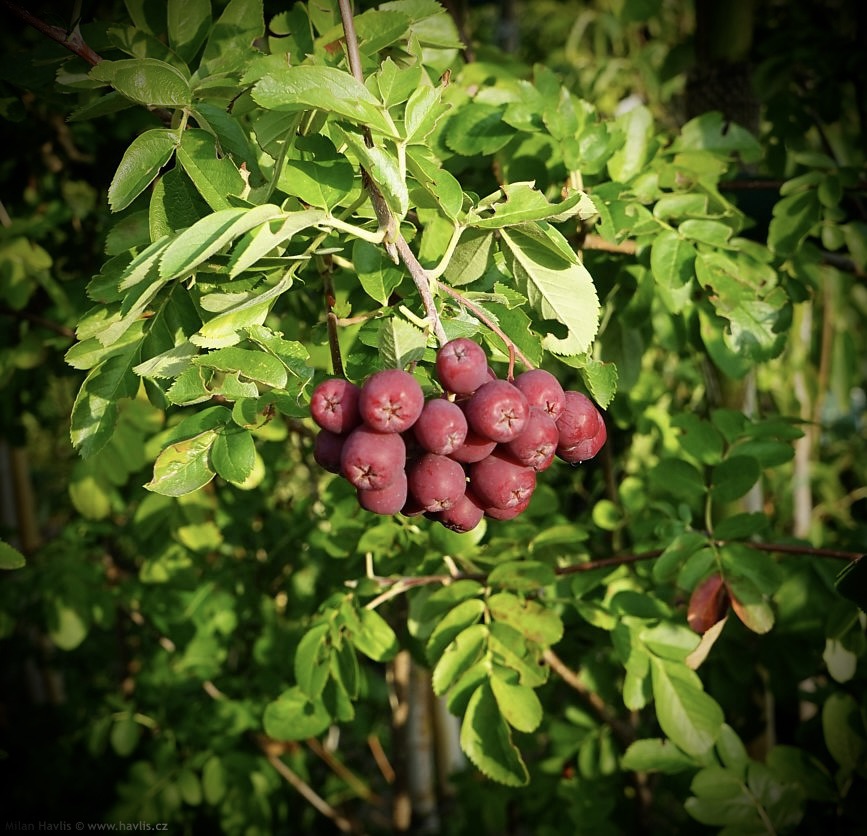
A few years ago, I began working with an extremely unique tree that I have developed a spiritual pact with. It’s a tree so unusual that it technically bares no common name and, instead, only has a couple of cultivar names and an undecided scientific name. The tree in question is one I have been calling a Rowthorn, since it is a cross between a Rowan Tree (Sorbus Acuparia) and a Hawthorn Tree (Crataegus Monogyna.) The resultant Crataegosorbus (or Sorbocrataegus, depending on your source) is a hybrid developed by Russian horticulturist Ivan Michurin in the 1920s, and can be phenotypically described as a nobbled Rowan tree with berries that look like rosy Haws the size of cherries. Miraculously, these Rowthorn berries are generally considered better for eating and cooking than either Rowan berries or Hawthorn berries are.
I was fortunate to acquire a sapling of this tree several years back. Over time, my relationship with the wight thereof has developed into something quite profound, and lately, I have found myself thinking more and more about the peculiar responsibility inherent in tending a spirit whose ancestry is, at once, remarkably new and descended from two trees of immense folkloric and magical significance. Namely, the Rowthorn is young. I do not mean merely that the particular tree in my keeping is young, though this is certainly true. I mean that the Rowthorn itself, as a distinct lineage of trees, has existed for scarcely more than a century. This is a peculiar thing to consider from an animistic perspective.
Many of the arboreal wights with whom magical practitioners have historically concerned themselves are beings whose reputations precede us by millennia. Their virtues have been observed, feared, petitioned, sung of, and transmitted across countless generations. They possess not only botanical lineages but vast folkloric inheritances. By the time we encounter them, we are stepping into relationships between humanity and the non-human world which began long before our births and will, hopefully, persist long after our deaths.
However, the Rowthorn possesses no such antiquity. It is the offspring of two archaic dynasties, but is itself a very young scion. And the more I have considered this fact, the more I have come to understand part of my responsibility toward this spirit as something akin to stewardship—or perhaps, in certain respects, tutelage.
There is an image which periodically comes to mind when I contemplate this relationship. Imagine a young princess born to two ancient and powerful royal houses. Her blood carries tremendous inheritance, and those who understand her parentage may recognize the possibilities latent within her long before she could comprehend them herself. But she is nevertheless a child. She has inherited a legacy without yet having had the time necessary to fully inhabit it. Someone charged with her keeping would occupy an unusual station. They would possess authority over certain aspects of her young life, but that authority would be neither absolute nor permanent. Its purpose would not be to diminish her sovereignty, but to prepare her for it. A tutor may know things a princess does not yet know, and a governor may temporarily make decisions which she is not yet equipped to make, but neither thereby becomes the source of her royalty. Indeed, if they fulfill their office properly, they are actively laboring toward the day when their charge will surpass the need for their governance altogether.
I have increasingly come to understand something similar in my relationship with the Rowthorn. For though I may currently possess greater experience than this young wight in certain respects, I do not believe this makes me spiritually greater than it. Rather, I believe I have found myself entrusted with helping something come into a fuller knowledge of what it already carries within itself. For the blood of the Rowthorn is extraordinary.
On one side stands Hawthorn, that ancient hedge-queen whose thorny boughs have marked boundaries between worlds for generations beyond counting. She is a tree of thresholds and sovereignty, of marriage and death, of protection and peril, and above all, of that old and complicated commerce between humanity and the Gloaming Folk. On the other stands Rowan, an equally ancient guardian, and no less numinous: scarlet-fruited, star-marked, protective, uncanny, and bound in its own complex ways to the realm of Faerie and Otherworldly power. I have sometimes found it useful—not literally, but mythopoetically—to think of these trees as belonging to something like the old royalty of the Elemental Otherworld.
And then there is their strange young child. Rowthorn. Bearing both inheritances and yet reducible to neither. This last point is important. If my role were simply to teach the Rowthorn how to behave like a Hawthorn, or how to wield the virtues of Rowan, then I would not truly be tending the Rowthorn at all. I would merely be attempting to force a new being into one of two preexisting molds. Yet, inheritance is not identity. Whatever Gloaming Legacy this wight ultimately comes to embody must necessarily arise from the meeting of its parentages within something new. And I cannot know entirely what that will look like. Neither, perhaps, can the Rowthorn yet.
This uncertainty is part of what makes the relationship so compelling to me. Most magical relationships with trees begin with some degree of precedent. We inherit stories telling us what Hawthorn does, what Rowan does, what Elder does, what Hazel does. Even where our direct experiences complicate those traditions, there remains a body of ancestral human observation against which those experiences can be compared. But there is no medieval Rowthorn lore. There are no centuries-old charms calling upon it. No country stories warning children what will happen if its branches are mistreated. No inherited feast days, taboos, songs, or spirit-doctoring traditions concerning its virtues. The Rowthorn entered the world too recently for any of this.
Accordingly, relating to such a wight requires a peculiar combination of attention and restraint. There is an enormous temptation, when confronted with a thing for which no folklore exists, to manufacture folklore ourselves. One could simply combine everything ever said about Rowan with everything ever said about Hawthorn, divide by two, and announce the resulting list as the magical properties of Rowthorn. But I think this would do the tree a profound disservice. Children inherit from their parents, but they are not equations made from them.
If I am truly to serve as steward to this young wight, then part of my responsibility must be to allow it the space to disclose its own nature. I can teach it something of its inheritance, insofar as such a thing is possible. I can introduce it ritually to currents and powers with which its parent trees have long been associated. I can observe the ways in which it responds. I can tend its physical body, protect it where protection is warranted, feed the relationship between us, and provide opportunities for its spiritual capacities to unfold. But I must also listen. Perhaps especially, I must listen. For there is a dangerous arrogance hidden in the idea of spiritual tutelage if one is not careful. The gardener can begin believing they invented the seed because they watered it. The teacher can mistake having provided language for having created the intelligence which learned to speak. Whatever I contribute to the Rowthorn’s development, its deepest inheritance is not mine to bestow. I am merely one of its keepers, and I find something profoundly moving about this station.
Occultists are frequently preoccupied with ancient powers. We seek old gods, old spirits, old grimoires, old traditions, old forests, old stones. Antiquity becomes so closely associated with spiritual legitimacy that we sometimes seem to forget that everything ancient was young once.
There must have been a first generation of humans who encountered every spirit now surrounded by venerable tradition. Someone was once among the first to discover what Hawthorn was capable of. Someone first learned what Rowan would tolerate. Someone made the first offering at a spring that would eventually receive offerings for a thousand years. Someone spoke the first charm that later became old. Perhaps we are occasionally born at the beginning of things. This possibility carries a different sort of responsibility from inheriting an established tradition. When one stands near the beginning of a relationship, one’s actions may become part of the conditions from which later relationships grow.
I sometimes wonder what the Rowthorn will be in another hundred years. Or five hundred. Perhaps it will remain an obscure horticultural curiosity, known only to collectors and the scattered people who happen to encounter it. Perhaps its lineage will disappear altogether. Plants, like cultures, are not promised perpetuity. But perhaps it will flourish. Perhaps Rowthorns will someday grow in hedges and gardens far beyond the few places where they presently occur. Perhaps other witches and magicians and spirit workers will independently discover virtues in them which I have only begun to glimpse. Perhaps stories will gather around them. Perhaps customs will emerge. Perhaps the wights themselves will deepen through generations of propagation, relationship, death, regrowth, and intercourse with the places in which they are planted. Just maybe, the young princess will discover her crown. If so, I will not live to see the fullness of her reign. And there is something strangely comforting about that.
My task is not to determine what the Rowthorn must ultimately become. Nor is it to possess whatever power it may one day wield. My task is much smaller: To tend one young tree. To uphold my compact with the wight who dwells through it. To help acquaint it with the tremendous Gloaming Legacy into which it was born, while leaving room for it to discover those mysteries which belong to Rowthorn alone. To protect without smothering. To teach without presuming authorship. To observe carefully enough that revelation is not mistaken for projection. And, perhaps most importantly, to understand that successful stewardship eventually renders the steward unnecessary.
If I fulfill my station properly, then whatever authority I presently possess within this relationship should diminish as the sovereignty of the Rowthorn increases. For the point of tending a young queen is not that she should remain forever a princess beneath one’s care. That would make the steward a grasping Regent. Instead, it is that, one day, she should have no further need of a governor.
And should the Rowthorn truly grow into the potency I believe sleeps within its strange and storied blood, then I hope that long after I have gone to join the Gloaming myself, something of my care may remain within its memory—not as the human who taught it what it was, but simply as one of those who recognized what it might become, and helped keep watch while it was becoming.
Image Source:
Milan Havlis, http://www.havlis.cz

